

our history
The Church
Designed by Henry Clutton, Emmanuel Church was built in 1861 and dedicated in 1862.

The church was built on land donated by the owners of Kinnersley and Hartswood Manors. It served as a place of worship for the local community, particularly for those who lived and worked on these estates. The benefactors also provided a Rectory nearby.
The church consists of a nave, chancel, northeast vestry (formerly the organ chamber), a tower positioned northeast of the nave, and a south porch.
Following World War II, restoration and improvements were made. In 1962, the organ was relocated from the Chancel Vestry to a newly constructed gallery at the west end. The church roof was also retiled.
In 1980, the parish was joined with St. Nicholas’ Church, Charlwood, under a single benefice.
After the Rectory was sold, additional improvements were made to the church. The west end of the nave was modified to include a ground-floor choir vestry, separated from the nave by sliding doors.
To enhance accessibility and functionality, a ground-floor accessible toilet was added. A first-floor meeting room with kitchen facilities, known as the Upper Room, was also constructed, requiring the extension of the organ gallery to its current position.
Lych Gate
George Henry Lindsey-Renton of Dovers Green erected the Lych Gate before he died in 1940 as a memorial to those in the parish who served in the First World War.
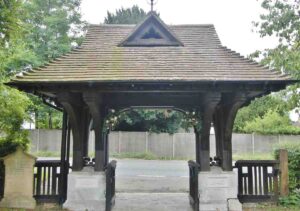
A plaque to commemorate those who lost their lives in the Second World War was added later.
Clergy
| Clergy Name | Years Served |
|---|---|
| Rev William Lees | 1861 – 1894 |
| Rev Aston L Whitlock | 1895 – 1927 |
| Rev Walter Alwyn | 1928 – 1953 |
| Rev Alex H Shergold | 1954 – 1971 |
| Rev Charles W Wall | 1971 – 1976 |
| Rev David G N Clark | 1976 – 1990 |
| Rev William G Campen | 1992 – 2015 |
| Rev Sue Weakley | 2015 – 2021 |
| Rev Sue Lepp | 2023 – Present |
Stained Glass
The church features remarkable stained glass windows, many of which were designed by the Victorian artist Henry Holiday.
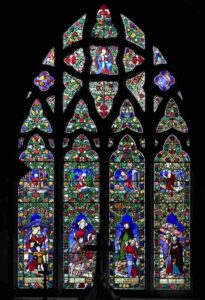
Like many churches across Britain, Emmanuel Church sustained damage during World War II. A bomb that fell in the fields to the south of the church shattered the south chancel windows and cracked the largest east window, which had to be replaced.
Organ
The organ, installed in 1862, is an excellent example of J. W. Walker’s early work. It was enlarged in 1910 to its current size, featuring two manuals, pedals, eight speaking stops, and associated couplers. The organ has a fully mechanical tracker action and has undergone a full restoration.
Font
The original font is located in the churchyard and is now used for floral displays. The current church font was salvaged from the derelict Chapel of St. Mary and the Angels in Duxhurst.
A brass plaque on the wall behind the font commemorates Lady Henry Somerset of Reigate Priory for her pioneering work at the Duxhurst Settlement, which she led from the late 1890s until her passing in 1921. A few vestments and ornaments from the Duxhurst Chapel were also donated to Emmanuel Church for safekeeping.